We welcome you to the Indian Residential School History and Dialogue Centre.

The records on our site emerge from the cultural and physical genocide that the Canadian government and churches conducted through the Indian Residential School System, including the ongoing impacts.

Bearing witness to these records may become overwhelming. If you are a Survivor or an Intergenerational Survivor and would like support, you can call the 24-hour National Indian Residential School Crisis Line at:

1-866-925-4419

Please click the button below for other cultural and mental health resources.

This is a Community Collection record. You are viewing it because you logged in as a member of a particular community.

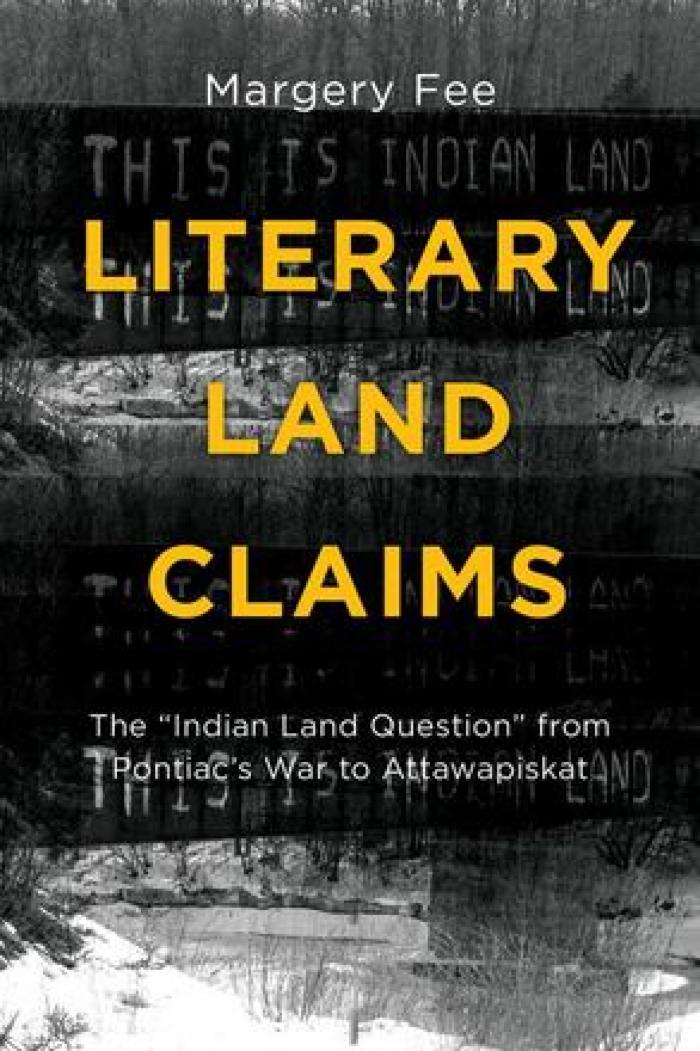
Literary land claims : the "Indian land question" from Pontiac's war to Attawapiskat
Image courtesy of Wilfred Laurier University Press

Literary land claims : the "Indian land question" from Pontiac's war to Attawapiskat
Xwi7xwa Library, University of British Columbia

2015
Book
Creators
Fee, Margery
Description
"Literature not only represents Canada as 'our home and native land' but has been used as evidence of the civilization needed to claim and rule that land. Indigenous people have long been represented as roaming 'savages' without land title and without literature. Literary Land Claims: The 'Indian Land Question' from Pontiac's War to Attawapiskat analyzes works produced between 1832 and the late 1970s by writers who resisted these dominant notions. Margery Fee examines John Richardson's novel about Pontiac's War and the War of 1812 that document the breaking of British promises to Indigenous nations. She provides a close reading of Louis Riel's addresses to the court during his trial in 1885, showing that his vision for sharing the land derives from the Indigenous value of respect. Fee argues that both Grey Owl and E. Pauline Johnson's visions are obscured by challenges to their authenticity. Finally, she shows how storyteller Harry Robinson uses a contemporary Okanagan framework to explain how white refusal to share the land meant that Coyote had to make a deal with the King of England directly. Fee concludes that despite support on social media for Theresa Spence's hunger strike, Idle No More, and the Indian Residential School Truth and Reconciliation Commission, the story about "savage Indians" and 'civilized Canadians' and the latter group's superior claim to 'develop' the lands and resources of Canada still circulates widely. If the land is to be respected and shared as it should be literary studies needs a new critical narrative, one that engages with the ideas of Indigenous writers and intellectuals"--back cover.

More Information

ISBN
9781771121194; 177112119X; 9781771121002; 1771121009; 9781771120999; 1771120991
Statement of Responsibility
Margery Fee.
Publication Information
Waterloo, Ontario : Wilfrid Laurier University Press
Physical Description
x, 316 pages : illustrations ; 23 cm
Notes
Indigenous studies series.
Includes bibliographical references and index.
Issued also in electronic format.

 
Contents
1. "How Can They Give It When It Is Our Own?": Imagining the Indian Land Question from Here -- 2. "Why Did They Take Our Hunting Grounds?": John Richardson (1796-1852) Laments for the Nation -- 3. "That 'Ere Ingian's One of Us?": Richardson Rewrites the Burkean Savage -- 4. "We Have to Walk on the Ground": Constitutive Rhetoric in the Courtroom Addresses of Louis Riel (1844-1885) -- 5. "We Indians Own These Lands": Performance, Authenticity, Disidentification, and E. Pauline Johnson -- 6. "They Taught Me Much": Imposture, Animism, Ecosystem, and Archibald Belaney / Grey Owl (1888-1938) -- 7. "They Never Even Sent Us a Letter": Harry Robinson (1900-1990) on Literacy and Land -- (In)Conclusion, or Attawapiskat v. #Ottawapiskat.
Permalink

Discussion

Do you have a story to contribute related to these records or a comment about this item?

Related

TOP