We welcome you to the Indian Residential School History and Dialogue Centre.

The records on our site emerge from the cultural and physical genocide that the Canadian government and churches conducted through the Indian Residential School System, including the ongoing impacts.

Bearing witness to these records may become overwhelming. If you are a Survivor or an Intergenerational Survivor and would like support, you can call the 24-hour National Indian Residential School Crisis Line at:

1-866-925-4419

Please click the button below for other cultural and mental health resources.

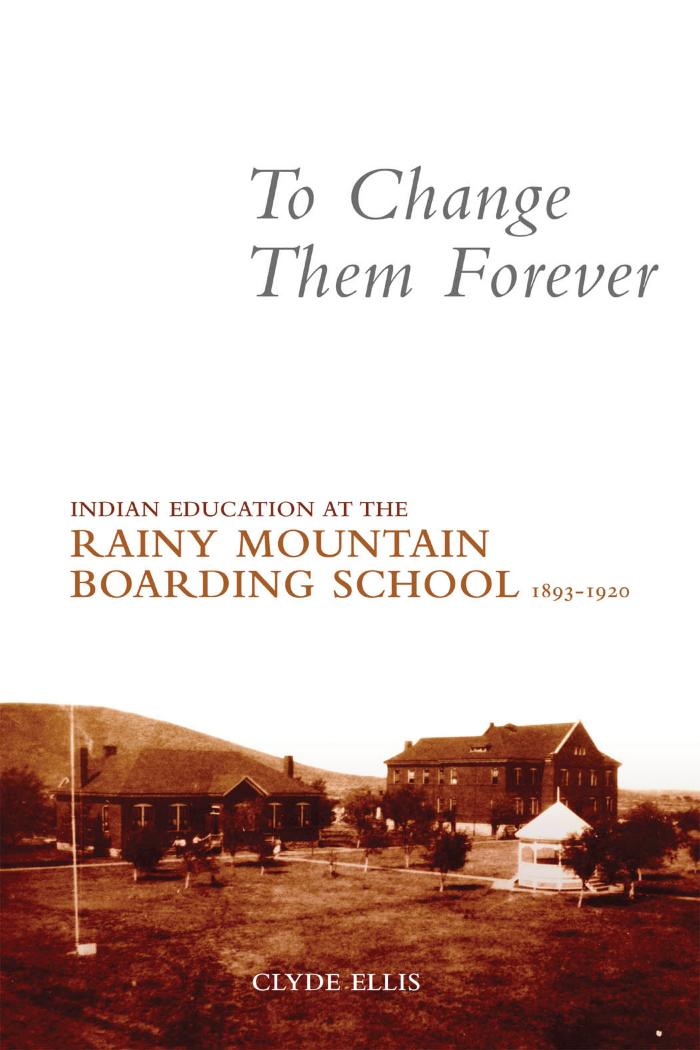
Image courtesy of University of Oklahoma Press

To change them forever : Indian education at the Rainy Mountain Boarding School, 1893-1920
Xwi7xwa Library, University of British Columbia

1996
Book
Creators
Ellis, Clyde
Description
"Between 1893 and 1920 the U.S. government attempted to transform Kiowa children by immersing them in the forced assimilation program that lay at the heart of that era's Indian policy. Committed to civilizing Indians according to Anglo-American standards of conduct, the Indian Service effected the government's vision of a new Indian race that would be white in every way except skin color.

Reservation boarding schools represented an especially important component in that assimilationist campaign. The Rainy Mountain School, on the Kiowa-Comanche-Apache Reservation in western Oklahoma, provides an example of how theory and reality collided in a remote corner of the American West. Rainy Mountain's history reveals much about the form and function of the Indian policy and its consequences for the Kiowa children who attended the school.

In To Change Them Forever Clyde Ellis combines a survey of changing government policy with a discussion of response and accommodation by the Kiowa people. Unwilling to surrender their identity, Kiowas nonetheless accepted the adaptations required by the schools and survived the attempt to change them into something they did not wish to become. Rainy Mountain became a focal point for Kiowa society."

More Information

ISBN
0806128259
Statement of Responsibility
Clyde Ellis.
Publication Information
Norman : University of Oklahoma Press
Physical Description
xix, 250 p.
Notes
Includes bibliographical references and index.
Contents
1. "It Is a Remedy for Barbarism": The Creation of the Indian School System -- 2. "No More Incongruous Spectacle": The Kiowas and Their Agency -- 3. "There Are So Many Things Needed": A Difficult Beginning -- 4. "We Had a Lot of Fun, but ... That Wasn't the School Part": School Days -- 5. "Education Does Not Eliminate These Differences": The Shifting Priorities of the Progressive Era -- 6. "Is It Not Time that Relief Be Furnished Rainy Mountain School?": Declining Fortunes -- 7. "The Kiowas Need Their School; They Cannot Very Well Get Along Without It": The Last Years -- 8. Conclusion: "Who Am I? I am a Kiowa": The Legacy of Rainy Mountain.
Permalink

Discussion

Do you have a story to contribute related to these records or a comment about this item?

Related

TOP