We welcome you to the Indian Residential School History and Dialogue Centre.

The records on our site emerge from the cultural and physical genocide that the Canadian government and churches conducted through the Indian Residential School System, including the ongoing impacts.

Bearing witness to these records may become overwhelming. If you are a Survivor or an Intergenerational Survivor and would like support, you can call the 24-hour National Indian Residential School Crisis Line at:

1-866-925-4419

Please click the button below for other cultural and mental health resources.

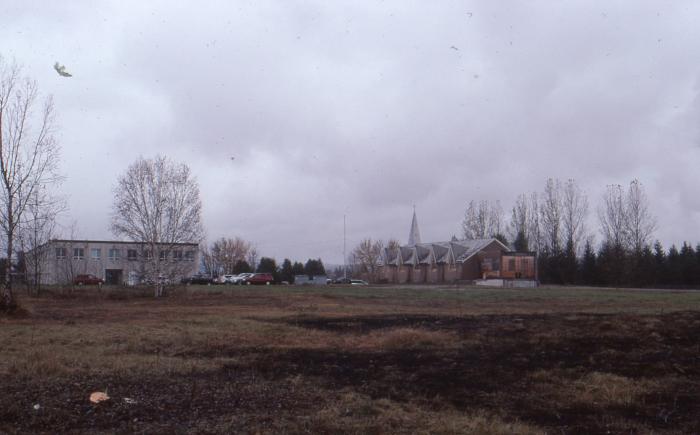
P2008-02-185 - Wickson - Site of former La Tuque Indian Residential School, QC (October 21, 2008). Source: The General Synod Archives, Anglican Church of Canada.

La Tuque (QC)

Dates of Operation
September 1, 1963 - June 30, 1978
Description
En 1963, on ouvre le pensionnat indien de La Tuque, au Québec, au nord de Trois-Rivières, sous la direction de l’Église anglicane. Le pensionnat est situé en ville de façon à offrir aux élèves l’occasion de s’intégrer aux écoles de la collectivité. Même si l’école se trouve au Québec, la langue d’enseignement est l’anglais. D’ailleurs, pendant un certain temps, on y utilise le programme d’enseignement de l’Ontario, plutôt que celui du Québec. Au milieu des années 1970, le français devient la langue d’enseignement pour la plupart des élèves. Le gouvernement fédéral prend la barre administrative de l’école en 1969, qui ferme ses portes en 1978. En février 2006, on fait démolir le pensionnat. (National Centre for Truth and Reconciliation)
Denomination
Anglican Church of Canada

More Information

Alternate Name(s)
La Tuque Pensionnat
Le Pensionnat des Indiens de La Tuque
Permalink

Map Information

Location
"Point is on the classroom building of the La Tuque Residential School, which was located on rue Brown in the town of La Tuque. In 2018, the building was used as a day care centre. Adjacent are the buildings that were formerly the staff residences and the principal's house. The dormitory building and chapel no longer exist" (Orlandini, 2019).
Location Credit
Morgan Hite and Rosa Orlandini. The school/hostel location data was collected by the Truth and Reconciliation Commission / National Centre for Truth and Reconciliation, Morgan Hite (Atlas of Indian Residential Schools of Canada), Stephanie Pyne (Residential Schools Land Memory Mapping Project) and Rosa Orlandini (Map and GIS Librarian, York University Libraries). The location data and associated attribute data was enhanced, revised and updated by Rosa Orlandini, in consultation with the Archivists at the National Centre for Truth and Reconciliation.
Location Source
Orlandini, Rosa, 2019, "Residential Schools Locations Dataset (Shapefile format)", https://doi.org/10.5683/SP2/FJG5TG, Borealis, V3, UNF:6:TTc1mMvx2BlBqBgIN05xVw== [fileUNF]

Discussion

Do you have a story or comment about this school?
TOP